Happy 2026! We look forward to welcoming students, staff, and friends to our Semester 2 research seminars and readings groups. Do get in contact if you would like to have Zoom details.
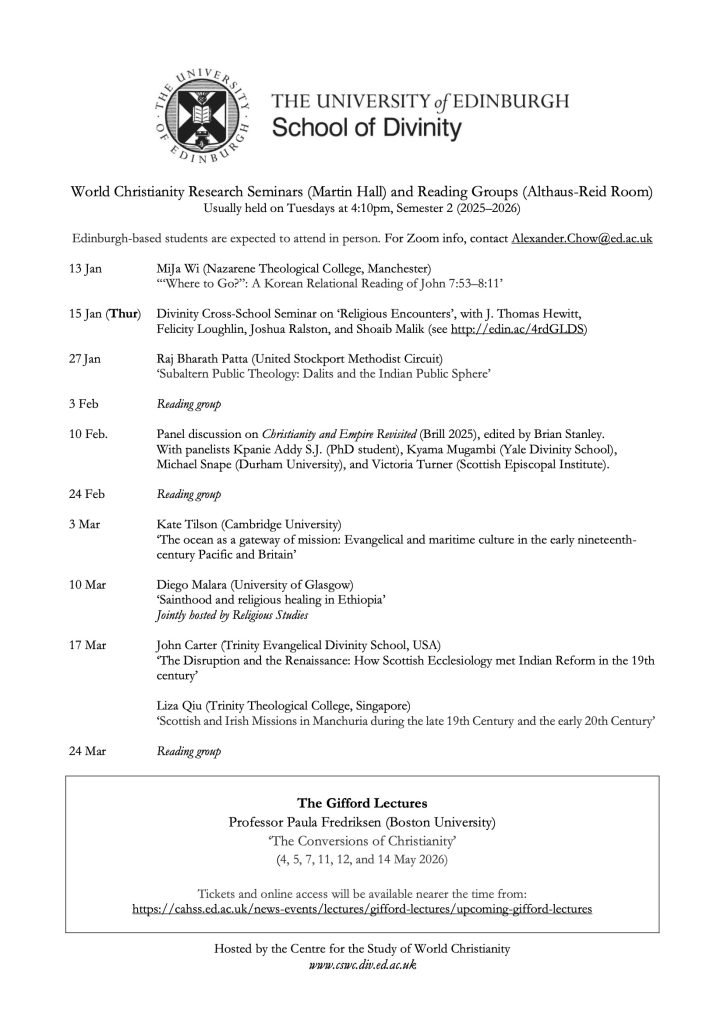

Happy 2026! We look forward to welcoming students, staff, and friends to our Semester 2 research seminars and readings groups. Do get in contact if you would like to have Zoom details.

This year marks the thirtieth anniversary of Studies in World Christianity, established in 1995. It has been the first and foremost journal to promote the academic discourse of World Christianity. Its history has included the publication of many field-defining articles. It also continues to be the outlet of choice for studies on the local and the global particularities of Christianity as a worldwide religion.
Thirty years on, it is worth correcting two common misunderstandings of the journal’s legacy. First, many automatically presume the journal was started by the historian Andrew Walls, the doyen of the field. Rather, the journal was established — not by Walls, but by that scholar of World Christianity studies James Mackey. Mackey? Who is James Mackey? I suspect many readers of this journal would not readily know this name, because he is rarely mentioned in standard primers on World Christianity. James Mackey was a Catholic theologian — and, no less, the Thomas Chalmers Chair of Theology and the Dean of the Faculty (now School) of Divinity at the University of Edinburgh. Importantly, this esteemed theologian established the journal during a time when ‘World Christianity’ was still a nascent discourse.
Popular, Folk, Grassroots and Pop Culture
in World Christianity and the History of Mission
10–12 June 2026 ‧ New College, University of Edinburgh ‧ #YaleEdin2026
Yale-Edinburgh Conference on World Christianity and the History of Mission
Deadline for Proposals: 1 February 2026

Christian communities, individuals, and institutions have always grappled with grassroots cultural expressions that surround them in different historical and social settings. This relationship has been riven with ambiguities. Songs, plays, and literature, print, radio, television, and the internet are deemed to edify or to scandalise, to propagate the Gospel or to profane it, to promote Christian virtues or to reject them, to encourage devotion or to deaden Christian sentiments. Missionaries have drawn upon familiar forms for hymns or folk traditions for liturgy. They have also eschewed popular songs and myths as antithetical to the Gospel. Majority World Christians simultaneously cultivate a ‘world-breaking’ attitude towards popular culture, casting off local traditions and customs as demonic, and a ‘world-making’ posture that positively engages local ontologies and folk cultures, like the Orthodox Anastenaria in which icons are displayed at festivals.
Continue readingWe are looking forward to beginning the new academic year next week, and especially in welcoming new students. Along with various reading groups and other activities for students, we are pleased to hold the following public seminars this Autumn.
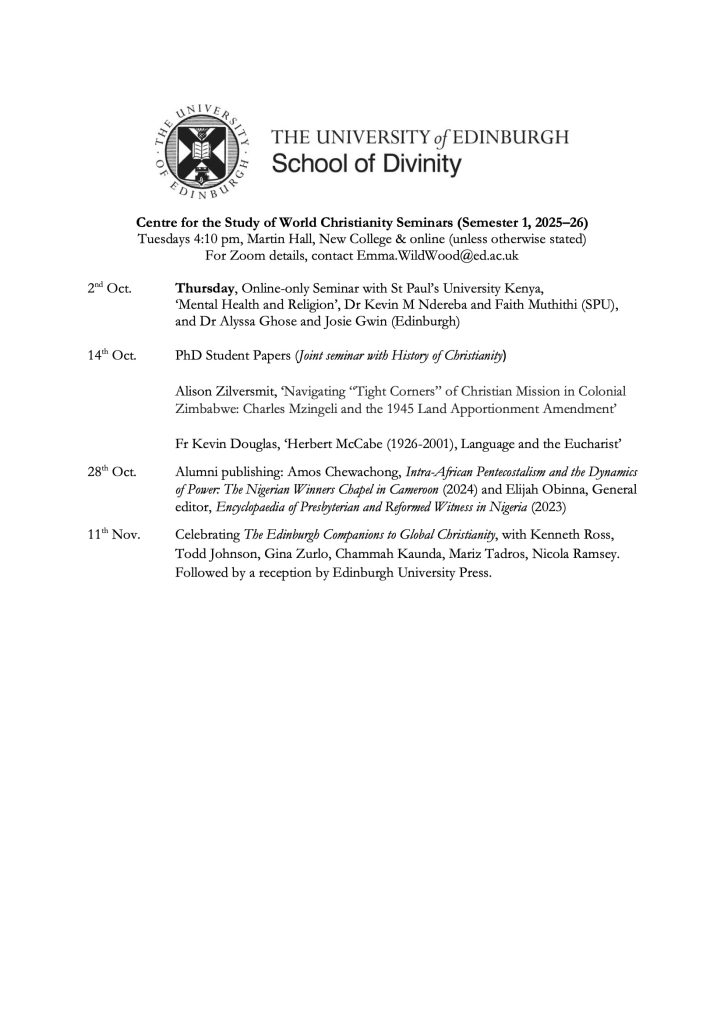
We look forward to seeing friends and alumni of the Centre in person or online. Do get in contact for Zoom details.