
Dr Fiona McCallum presenting in New College

Dr Fiona McCallum presenting in New College
The Centre for World Christianity co-hosted a one-day conference on ‘Women in the World Church’ to explore the historical and contemporary role of women in global Christianity on 16 September 2017. 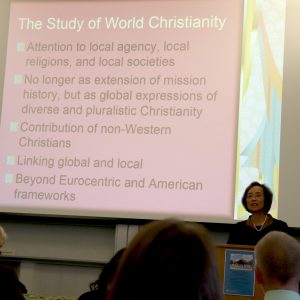 The title address came from guest scholar Professor Kwok Pui-Lan, an Asian feminist theologian, who focused her remarks on both the women who helped to build the growing Christian communities in the Global South and those of the women missionaries who served them.
As one of a panel of respondents from the field of Arab Christianity, I focused my remarks on a portion of Professor Kwok’s thesis:
The study of the agency of local Christian women must take into consideration the wider social, historical, and political environment in which these women lived.
As I consider the field of the world’s Christianity in which I aim to specialize – contemporary Christianity of the Arab world and of Jordan in particular – I would consider the effects of such environments on local Christian women as well. They have not always affected them, or myself, as I first expected. Continue reading
 I was invited to respond to Professor Kwok Pui-lan’s paper, and share about being a woman in the Zomi church. Professor Kwok highlighted the somewhat contradictory nature of freedom that many missionary women experienced. She noted that although mission work allowed women to have a profession, they were still nonetheless working within the confines of set gender roles and Victorian notions of domesticity. Their work was ‘woman’s work’, and they received low wages if any. For me, as a Zomi woman, her remarks reminded me of the current situation of many women in my community. Continue reading
This review was originally posted here.
 Recent historical scholarship on modern Christian missions to China, as to the non-European world as a whole, has been bedeviled by two weaknesses. First, historians have written about Protestant missions to China, or less frequently about Catholic ones, but very rarely about the two together within a single monograph. Second, Anglo-American scholars have tended for obvious linguistic reasons to confine themselves to the study of British or American missions, to the general neglect of those from continental Europe. Not the least of the virtues of Albert Monshan Wu’s book is that it transcends both of these limitations at once. By selecting as his two case studies in missions to China the Protestant Berlin Missionary Society (BMS) and the Catholic Society of the Divine Word (SVD) Wu is able to illuminate both commonalties and dissimilarities across the confessional divide. Continue reading