Studies in World Christianity 32.1

Familiar Themes, New Angles

The articles in this issue present new angles on familiar themes within World Christianity. Translation, the regional histories of churches and organisations, material aspects of religious belonging, and diasporic Christianity are all explored here. Particular case-studies in specific geographical locations are examined in each article. Yet each article also acknowledges the ways that Christians in one area relate to those in another part of the world. The intersection of a specific context and the actors’ wider connections are the ingredients for exploring a theme for a fresh perspective.

In each of these articles, attention to a specific place and organisation allows the authors to examine new aspects of wider themes, furthering knowledge and understanding of World Christianity as both local and global, distinct and interconnected. Reading these articles, we observe how and why translation and interpretation of key concepts shaped a Christian movement, how far regional histories of global organisations and women’s groups in mission-initiated churches disseminate and adapt Christian practices and values. We learn in what ways material aspects of religious identity influence behaviour and belonging, and how diasporic churches live their fellowship in marginal and hostile environments.

Continue reading
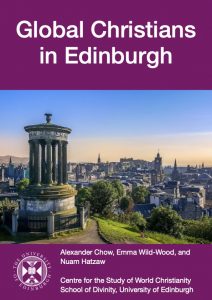
Global Christians in Edinburgh

The Centre is pleased to have begun work on the ‘Global Christians in Edinburgh’ project.

From December 2022 to June 2023, the project sought to offer a baseline of the global diversity of Christianity in Edinburgh and the collaborative efforts of these communities. It coincides with a historic period of both downturn in many historic Edinburgh churches and upsurge in Christianity amongst migrants coming from Africa, Asia, Latin American, Oceania, and other parts of Europe, resulting in the creation of new fellowships, (sub)congregations, and worship services/mass.

For more information about the project and the report released in July 2023, see our dedicated project page.

Studies in World Christianity 29.2

World Christianity: Retrospect and Prospect

The academic field of World Christianity, as we know it today, owes no small debt to the Yale–Edinburgh Group on World Christianity and the History of Mission (formerly known as the Yale–Edinburgh Group in the History of Missions and World Christianity). The term ‘World Christianity’ itself has much earlier vintage. It arose from within the ecumenical movement of the first half of the twentieth century and, as such, reflected the twin imperatives of unity and mission. However, the term fell out of use until the 1990s. It was at the inaugural Yale–Edinburgh Conference in 1992 when the term ‘World Christianity’ was again deployed, this time as the conference theme, ‘From Christendom to World Christianity’. That first meeting was held on the 500th anniversary of Columbus’ arrival in America. As Dana Robert recalls, it signified ‘a postcolonial stance of moving beyond European Christendom of the old [Kenneth Scott] Latourette approach to mission history’ that focused on the geographic expansion of Christianity, ‘to that of indigenous initiative and Christianity as a multicultural religion not tied to one hemisphere’. Started by former colleagues Andrew F. Walls and Lamin Sanneh, holding meetings at their respective institutions, the Yale–Edinburgh Group became a seminal discursive space for a postcolonial approach to mission history. It also brought to light the importance of documenting and preserving historical archival collections associated with Christianity as a worldwide phenomenon.

Continue reading

Studies in World Christianity 29.1

Women in World Christianity: Navigating Identities

Edited by Nuam Hatzaw and Jessie Fubara-Manuel

Leading Ghanaian theologian Mercy Amba Oduyoye describes theology without the inclusion of women as a one-winged bird – hindered and unable to soar to its full potential. In her opening address at the inaugural meeting of the Circle of Concerned African Women Theologians (the Circle) in 1989, she contended that African theology needs to pay proper attention to women’s issues, experiences and theological reflections in order that it might be a two-winged theology that can take full flight. Oduyoye’s comments highlighted the pervasive omission of women’s voices within religious institutions and theological and religious studies literature. Despite women’s important and pivotal roles in these arenas, their contributions, perspectives and needs have gone consistently underplayed, or been otherwise dismissed.

Continue reading