As we begin our academic term, we are glad to once again restart our in-person research seminars. Unless otherwise stated, seminars are held fortnightly on Tuesday afternoons in the Elizabeth Templeton Room. Please direct queries to Emma.WildWood@ed.ac.uk.
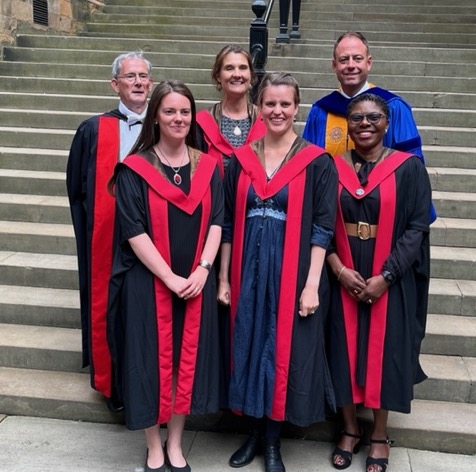
Drs Marteijin, Fubara-Manuel and Schouten, with supervisors Profs Brian Stanley and Emma Wild-Wood & Dr Joshua Ralston
Four students from Centre for the Study of World Christianity received their doctoral awards at the University of Edinburgh graduation ceremony last week. They were among sixteen doctoral students and about 60 undergraduates from the School of Divinity. Many congratulations to:
The Centre for the Study of World Christianity is delighted to announce the appointment of Dr Pedro Feitoza as Lecturer in Latin American Christianity, from September 2022.
Pedro is from Brazil and currently a postdoctoral fellow at the Brazilian Centre of Analysis and Planning (CEBRAP) in São Paulo. He completed his PhD, ‘Protestants and the public sphere in Brazil, c.1870-c.1930’ in 2019 from the University of Cambridge. A monograph from the thesis will be available shortly.
Edited by Afe Adogame, Raimundo Barreto and Richard F. Young
There is sometimes an assumption that Christianity operates, grows and develops in a historical, social, cultural, political and religious silo or context. This is hardly the case. Christianity, past and present, has shaped all geographical, religious and cultural contexts in which it has found itself, but all these various contexts, cultures and religious traditions have in turn also had an impact on Christianity in manifold ways. An exploration of this reciprocal interaction is important for our global age. Christians once viewed the world in split-screen mode: there was Europe, the centre of the faith, and there was the rest of the world with large swaths of non-Christian lands that were ripe for the work of missionaries. However, over the last century an enormous growth in Christianity across the Global South and a drop in the proportion of Europeans and Americans who identify as Christian has upended that perspective. The centre of gravity has shifted from the Global North, serving notice that the future of the faith will look increasingly diverse and dynamic.
The study of World Christianity seeks to understand how Christian communities embody historical and cultural experiences locally and globally; as such, it fosters the study of both local and translocal ways of knowing and doing. Thus, World Christianity hardly exists in a historical and socio-cultural vacuum; it encounters, affects, and is in turn impacted by local, indigenous worldviews, religions and cultures. The complex historical and socio-cultural encounters of worldviews, religions and cultures at the root of Christian communities in a variety of contexts demand further understanding and analysis. The selected, peer-reviewed essays in this issue, originally presented at Princeton’s Third International Conference (2021), explore and reflect on such a diversity of local, indigenous expressions and experiences of Christianity, their encounter with other religious traditions, and the variety of ways they interact with one another critically and constructively across time and space. While based on case studies, they focus on ethnographic practices and new methodological directions. Common themes addressed include conversion, translation, identity, missions, materiality, migration, diaspora, intercultural theology and interreligious dialogue.